
In the next instalment of our series of interviews with PhD students in climate research, PLOS Climate speaks to Nuwahereza Nelson of…
PLOS Climate PhD interview: Dalena León Fon Fay
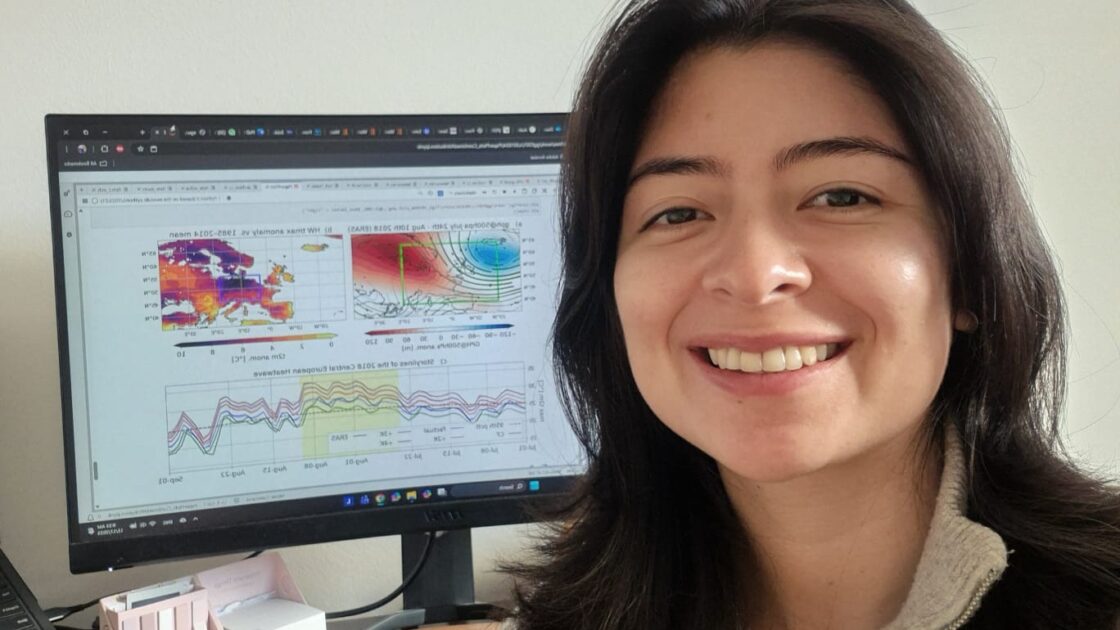
In the first of a new series of interviews with PhD students in climate research, PLOS Climate speaks to Dalena León Fon Fay of the Helmholtz-Zentrum Hereon.
What did you study before your PhD, and why did you decide to go on to do a PhD?
I studied Physics in Yachay Tech University, in Ecuador, where I’m from. During this time, I got involved in many different fields, from experimental material science to theoretical/computational quantum physics and fluid dynamics. All of them had something interesting, but none fully captured my attention. At some point, fundamental physics seemed too abstract for me… I wanted to explore a field where I could have a tangible impact on society. So, Climate Physics seemed like the right next step.
I did a Master’s in Ocean and Climate Physics at Hamburg University in Germany, where I’m based now. There, I found interest in extreme events and the polar regions. Both through my student assistant job and during my master’s thesis, I gained insight on how research is done within academia, and I just liked it. Even though I enjoy doing research, it can be quite exhausting and overwhelming. Therefore, it was still a hard decision whether to continue with a PhD or not. In the end, I decided to give it a try, under the main criterion of joining a group with a nice working atmosphere and supportive supervision. After all, for the next –at least– 3 years your life will revolve around it. For me, the research topic and institute were secondary when choosing a PhD. I truly believe that good science comes from a supporting working group that guides you and reminds you that research is not linear, that it is okay to fail and that there is always an alternative solution.
I am now starting my third year of PhD in Climate Extremes and Attribution at Helmholtz-Zentrum Hereon in collaboration with Hamburg University, Germany. I can only say that I am happy with this journey, with all its ups and downs. I hope I can continue doing science and communicating the effects of global warming.
Could you tell us about your project? What are the key questions you’re hoping to address, and what methods/approaches are you using?
My overall aim is investigating the effect that global warming has on extreme events (attribution). I use a method called Spectrally Nudged Storylines, which basically shows alternative pathways that a specific extreme event could have had in the case of occurring in the absence or an intensified global warming.
Let’s say we’ve recently experienced a very severe drought in our home country, which led to several consequences like water scarcity in our neighborhood, crop failure, or power outages in the entire country. Or a heavy storm that caused our house to flood and caused landslides in our city. A pre-industrial storyline of this event would show what could have happened instead, in the absence of anthropogenic global warming. Maybe there was still a drought or a storm, but not intense enough to lead to such severe consequences. In this way, we aim to communicate the effect of global warming based on ‘what if’ scenarios of events that are connected to personal experience. In my latest work, I am extending this attribution approach to be able to say how likely these alternative storylines are by presenting a combined statistical-storyline attribution approach.
What excites you most about your project, and about the wider field?
What interests me the most about my project is the versatility it has. Since we have a global dataset for past, present and warmer world storylines, I can study several kinds of extreme events (especially those mainly driven by thermodynamics and that can be modelled at a ~60km resolution) occurring anywhere in the world between 2015 – present. I also like the concept behind storylines. They let us explore how the same event could evolve in different worlds in a physically consistent way. It’s a nice complement to other attribution approaches that communicate the change in likelihood of extreme events due to global warming. Instead of focusing on the change in probability, it focuses on the physical changes that an event could undergo, and can serve as an input for impact models to see how the same event could affect different sectors under alternative scenarios. This has a significant output in society, as it is important to communicate from different perspectives how global warming is shaping the extreme events we’re already experiencing and what we might face in the future.
Where you would like to take your career next?
I’ve never had a concrete plan, nor did I imagine doing what I do now. I just knew that I wanted to do science, and I still stand by that. For what’s coming next, I see myself working as a climate researcher, continuing to make progress in climate extremes attribution and extending the field towards less represented regions in the Southern Hemisphere. Of course, I am aware of the current situation in academia, and the difficulty of young scientists finding permanent positions arises insecurity. Despite the uncertainty, I’m willing to stay in the field, but keeping realistic thoughts on the possibility of making a change in my career if needed.
What are your thoughts on the future of climate research?
I think climate scientists have still much more to investigate, but the main message was delivered decades ago: ‘human activities have changed the natural evolution of the climate system’. Still, the message has not been entirely received by the public. There remains a clear need to communicate and keep reminding us of the consequences of global warming so that policies and adaptation measures can be implemented.