
In this interview, we get to know Maya Ben-Yami of the Potsdam Institute for Climate Impacts Research, who recently joined PLOS Climate…
PLOS Climate PhD interview: Krishna Girish
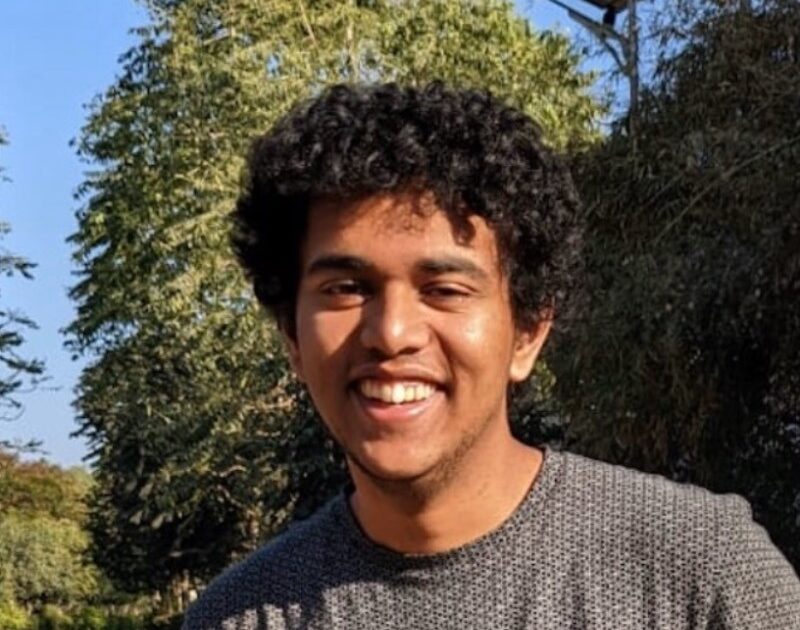
In our latest interview with a PhD student in climate, PLOS Climate speaks to Krishna Girish of the BioDICée group at ISEM, Université de Montpellier, France.
What did you study before your PhD, and why did you decide to go on to do a PhD?
Before my PhD, I studied for a BS-MS dual degree in Biology with a minor in Mathematics at the Indian Institute of Science Education and Research (IISER) in Pune, India. The IISERs are a set of seven institutions across India specialized in scientific research, and it was an incredibly enriching experience for me finding myself in that environment surrounded by other young scientists. The IISER curriculum is also highly supportive of undergraduates contributing to research in the form of projects and internships – through these, I found that I loved the act of doing science, exchanging ideas, and building up an understanding of a topic or challenge.
Having been an avid birdwatcher since I was six years old, and witnessing several ecological crises growing up in the rapidly expanding city of Bangalore, India (including Bellandur Lake, 3km from my house, becoming so polluted it that its surface caught fire), I found myself drawn to research in ecology. I was also simultaneously enjoying courses in applied mathematics, and how it could be used to predict and generalize properties of complex systems. With these interests, I tried to settle at the interface of the two in the form of quantitative ecological modeling, with a particular interest in building predictive models of the fate of ecosystems in the face of changing climates. I did research internships looking at using birdwatchers’ checklists to model how mountain birds move ranges upwards in response to climate warming and how plants can acclimate to handle extreme heat. I also was at the Massachusetts Institute of Technology for my master’s thesis, modeling ecological recovery to wide-scale disturbances using the gut microbiome as a model system.
After graduating, I was fairly certain I wanted to continue down the path of doing ecological research. I worked for a year as a research associate in the Biodiversity Dynamics team at the University of Montpellier in France, which I greatly enjoyed – so when I was offered a PhD in the same group, I continued there, where I am starting my second year now.
Could you tell us about your project? What are the key questions you’re hoping to address, and what methods/approaches are you using?
My project is part of a wider pan-EU consortium called ClimTip, where we assess the impacts of planetary-scale climate tipping events on the Earth system. These are (hopefully!) low-probability but high-impact events where one of the sub-components of the global climate system collapses irreversibly into an alternate equilibrium state, with drastic consequences for worldwide climates. We are specifically assessing the climate impacts of the weakening of the AMOC (Atlantic Meridional Overturning Circulation – the main warm-water current through the Atlantic) and the dieback of the Amazon Rainforest.
Within this consortium, my PhD project explores the consequences of these climate tipping events for biodiversity and ecosystems worldwide, developing macroecological-scale predictions of impacts on species. I’m doing this largely using the framework of climate exposure, commonly used in vulnerability assessments for biodiversity. The idea is to model the realized limits of different aspects of a species’ climatic environment over its geographic range, such as the maximum/minimum temperature or precipitation, the seasonality, and the properties of extreme events like heatwaves or droughts. Then, using future projections, I see where species are exposed in the future to climatic conditions outside these limits, representing conditions more extreme than they have ever seen in the past.
Through this, I hope to identify drivers of the major climatic factors that present exposure risks to species in different scenarios, identify where and which types of species are most at risk, and isolate the incremental effect of climate tipping events over and above expected risks from warming alone.
For the first sub-project within my PhD, I used historical climate data over the last 80 years to compile a standardized set of historical limits in the form of a database called ClimLimits. Then, using this, I am using future projections with and without tipping points from the ClimTip project to compare exposure patterns. Finally, I hope to integrate this with land-use projections to identify where species are likely to be most at risk and require major conservation efforts in the coming century.
What excites you most about your project, and about the wider field?
My hope is that my PhD project will show where we should be most worried about biodiversity in the future, and provide a preliminary diagnosis of how climate risk to species emerges and amplifies. Essentially, given our limited conservation ability and resources, where should we be focusing our efforts, if we look towards future climate risk as a driver of extinction? I think the idea of being able to predict where ecosystem disruption is likely to occur on a global scale is very exciting, especially in the face of tipping events, where there is likely minimal time for species to adapt to the rapidly appearing novel conditions. For example, I would love to know what specific aspects of climate-driven exposure risks to species in a given region (say, the Arctic), and if this pattern is significantly modified given AMOC weakening.
I think climate science and ecology have always had a lot of excellent cross-pollination of ideas and themes. The intrinsic coupling between the state of climate, ecosystem health, and the persistence of human societies is a nexus that is increasingly starting to come into focus; I’m excited to explore this space and see what emerges in the near future.
What are you hoping to gain through the experience of doing a PhD?
The fundamental premise of a PhD has always appealed to me: taking an idea and, given the time and resources to explore it deeply, seeing what interesting things I can learn from it. So, one major goal for me is to actually build that skill of independent synthesis – the ability to be able to take something from raw data to a finished product, being mindful of all the impacts it has and the caveats and consequences associated with that. Especially in a field like climate change ecology, being clear about what your work can or cannot show is crucial to synthesizing ecosystem vulnerability, and identifying paths forward to environmental protection.
Especially at this juncture of time, I also believe that as quantitative ecologists, we have a crucial duty to produce tangible, actionable outputs from our work that can be used by people working in grassroots conservation or in building local-scale climate resilience. In accordance with this, I hope to develop skills to distill scientific research into directed action plans, especially for the Global South.
Finally, I think studying large, chaotic systems like the climate or the biosphere necessitate a wealth of diverse perspectives, both from a scientific perspective as well as in terms of how to interpret and act on scientific results; thus, I hope to establish collaborations where we can meaningfully learn from each other, and leverage each others’ skills into useful, impactful work.
What are your thoughts on the future of climate research?
I think a lot of wonderful climate research till date has mapped, in magnificent detail, the scale, extent and risks of climate change. With its magnitude accelerating in the years to come and the ensuing impacts on human societies and livelihoods, I believe there might be a tipping event, so to speak, of reorienting these tools to shift more research into developing mitigation measures and testing recovery/adaptation strategies. At the same time, I think there is a lot of work to be done in communicating what can still be done as the general public becomes increasingly aware of the scope of the crisis.