
Many of the sessions, including keynote speeches and deep-dive panel discussions, from World Water Week 2025 are now available via their YouTube…
Why World Water Week is A Safe Harbor We Keep Coming Back To
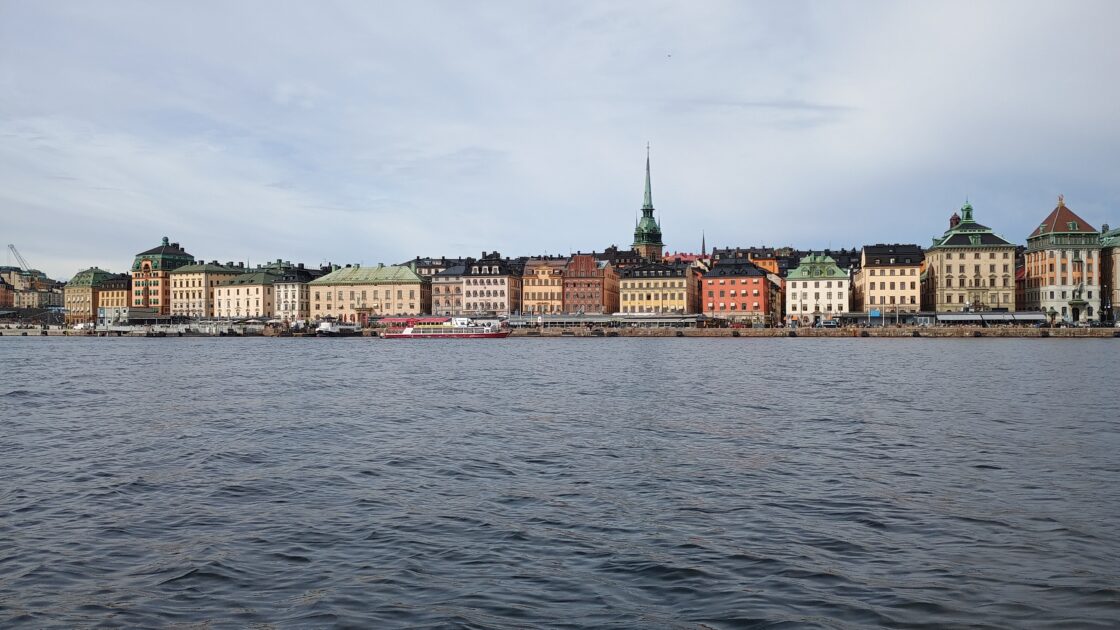
Image credit
Picture by Jamie Males
Many of the sessions, including keynote speeches and deep-dive panel discussions, from World Water Week 2025 are now available via their YouTube channel.
Isabell Hedke reflects on World Water Week 2025, the leading conference on global water issues. She is a young health and water professional, and is part of the Scientific Programme Committee for World Water Week.
Like a harbor for ships, World Water Week is a place where the global water community returns to each year at the end of August. Organized by the Stockholm International Water Institute, it brings together diverse actors who share one major commonality: their connection to, passion for and understanding of water.
A Meeting Point for People.
A harbor brings together sailors, travelers, workers and others from across the world – fostering exchange, diversity and connection. Historically, Stockholm has long served this role in real terms: as an important harbor in the Baltic Sea, connecting Sweden to international markets and cultures for centuries. World Water Week resembles that spirit by uniting participants across borders, generations and disciplines. Everyone brings unique perspectives, skills and solutions and each year, new people and organizations join World Water Week, adding fresh voices and new insights. It continues to be a living and evolving network, rather than a fixed community – which is both its strength and its challenge.
As water connects everything, no single person or organization can paint the full picture. The harbor and likewise, World Water Week becomes a space where we attempt to paint that picture together. As Susanne Halling Duffy, Director of World Water Week puts it:
“This is where global communities meet – to connect, challenge and create. (…) As we all know, the real heart of this conference is you – the participants.”
A Meeting Point for Experiences.
Harbors are places of exchange. Ships arrive, get loaded and unloaded, before they depart again. At World Water Week, these “ships” are ideas, projects, partnerships and experience. They are unpacked during workshops, presentations, meetings, side events and the unstructured in-between moments – coffee breaks, shared meals or morning swims. This is where people learn from one another’s successes and failures, build on ideas and take-home lessons.
Taylor Galvin Ozaawi Mashkode-Bizhiki, graduate student, water protector and knowledge keeper of the Brokenhead Ojibway Nation, shared:
“Our water is so sick and is so hurting in my home community. We can’t even drink from the rivers anymore. We can’t swim in the lakes.”
This testimony served as a reminder that while we discuss frameworks and indicators, water injustice is not abstract — it is painfully present in too many communities. Insights like these can help to humanize data, change narratives, drive empathy-based solutions and inform policy with ground-level realities.
A Meeting Point for Cultures.
World Water Week also functions as a cultural harbor – where traditional knowledge meets science, where Indigenous and youth voices meet institutional expertise and where local realities and global strategies coexist. This blending of perspectives is necessary, but not easy. When done right, it opens up a shared ground for communities that do not often meet.
Janice Li, Curator at the Wellcome Collection, joined a panel on the science behind water, climate and health. She reminded us:
‘We must look at patterns of water-related breakdowns through – and beyond – science, to look deep into history and archaeology, in the arts, learn from traditional ecological knowledge and the social fabrics of communities, in order to understand that ingenious solutions lie within the intricate web of life.’
These conversations challenge us to understand that bringing diverse forms of knowledge into one room is not enough. There need to be ways of embedding these into decision-making processes, rather than being treated as side events or symbolic inclusion.
This year, participants celebrated the first-ever World’s Lake Day on August 27th. Almost 100 water leaders held hands and jumped into the waters surrounding Stockholm – a simple yet powerful symbolic gesture which reminded us that water is not just a topic we study but something we live in, care for, and belong to. As Henk Ovink, Executive Director of the Global Commission on the Economics of Water underscored:
“The relationship with water brings us together, it creates the opportunity for minimising barriers and creating bridges across cultures”.
A Meeting Point for Solutions.
Because a harbor is a point of connection, it naturally becomes a place where problems ask for solutions – through exchange, cooperation and opportunity. World Water Week continues to grow as an interdisciplinary space, bringing in sectors such as health, food, energy, finance and climate. These intersections are essential, but intersecting once a year is not enough.
What stood out during the week was how aligned many seemed to be – in urgency, in values, and the desire to do better. There is a common understanding of what is important and that it can only be achieved by working together. But collaboration remains difficult – especially after leaving Stockholm. Geography stretches us apart. Bureaucracy slows things down. Internal processes take over. Incentives do not always align. As World Water Week offers a space to bridge silos, ask difficult questions and plant seeds in each other’s minds – the real challenge is to sustain that ground.
A Meeting Point in Crisis – A Safe Harbor.
A harbor is also a place of shelter – a place to rest, to recharge and to reflect in the midst of storms. World Water Week has long offered that shelter. For 35 years, it has remained one of the few global forums, where water really takes center stage. Here, participants share their frustrations and hopes, their failures and breakthroughs – not just as professionals, but as humans. But as John Augustus Shedd famously said:
“A ship in harbor is safe, but that is not what ships are built for.”
We come to Stockholm to connect, to listen and to challenge each other, leaving with new knowledge, new partnerships, and most importantly: a sense that no one is navigating alone. But what we take with us must be more than inspiration.
We must carry the sense of urgency, the openness to being challenged and the willingness to collaborate in spite of barriers. While it is comforting to know we will gather again in Stockholm, the challenges we face do not pause until next August. And so the harbor is a place to regroup – not to remain.